
GPS monitoring in domestic violence cases exists to enforce one thing above all else: distance. An exclusion zone is a mapped area the monitored person is not permitted to enter, and if they cross into it, the device reports it. Not at the next check-in. Right then.
That is the whole idea. A no-contact order written on paper depends on everyone honoring it. An exclusion zone attached to a GPS device turns the same instruction into something the court can actually verify.
What Is an Exclusion Zone?
An exclusion zone is a geographic area a monitored person is prohibited from entering, drawn on a map and programmed into the monitoring platform. Its opposite is an inclusion zone, which is a place the person is required to be at certain times, usually home.
Our post on what triggers a GPS monitor alert covers the full range of zone types and other alert conditions. What follows here is specific to how zones are used when the court’s concern is another person’s safety.
How Are Exclusion Zones Set in a Domestic Violence Case?
The court decides, not the monitoring company and not the monitored person.
In a case involving family violence allegations, the zones typically center on the places the protected person can be expected to be. A home address is almost always the first. A workplace is frequently the second. Beyond that, zones are often drawn around a child’s school or daycare, a relative’s home, or a specific business the protected person uses regularly.
Each zone is set with a radius rather than a property line. That buffer exists deliberately, because a boundary drawn tight to a building would be crossed by anyone driving down the adjacent street. The size of that buffer is a decision the court makes based on the circumstances of the case.
Zones can also be layered. A person may be excluded from several areas at once while being required to remain within a broader region overall, and those instructions coexist on the same device.
What Happens the Moment Someone Enters an Exclusion Zone?
The device registers the entry and transmits it. There is no delay built in for explanation.
A GPS unit like the Omnilink OM500 sends location data continuously to a monitoring platform, and entering a restricted area is one of the conditions that generates an alert. The monitoring center receives it and follows the notification protocol the court has established for that case, which ordinarily means contacting the supervising officer and documenting the event for the court overseeing the case.
The record matters as much as the alert. Zone entries become part of a location history that shows time, duration, and path. A brief pass through the edge of a zone on a highway looks very different in that record than a stationary hour two blocks from a protected address, and that distinction can be the difference between a conversation and a serious problem.
Who Finds Out About a Violation?
This depends entirely on what the court has ordered, and it is worth asking about directly rather than assuming.
The consistent part is that alerts go to the monitoring center and from there to the supervising officer and the court overseeing the case. Whether a protected person receives any form of direct notification is a decision the court makes, and it varies by jurisdiction and by case. A 2nd Chance Monitoring follows the notification structure the court sets.
If you are the protected person in a case and want to understand what you will and will not be told, the court and the prosecuting attorney’s office are the right places to ask. If you are the person wearing the device, your attorney and your supervising officer can tell you exactly who sees what.
Which Devices Are Used for Exclusion Zone Monitoring?
Two GPS devices handle this work.
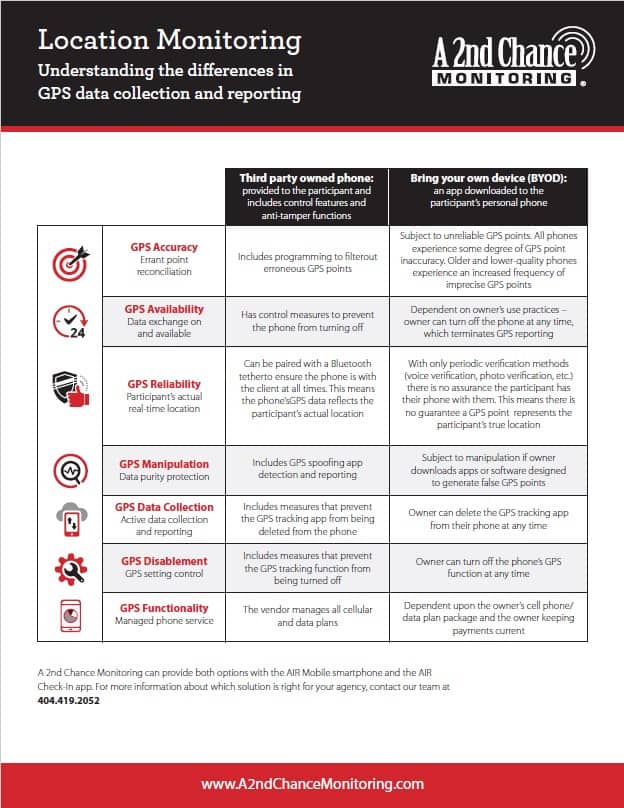
The Omnilink OM500 is a one-piece ankle unit that combines cellular, satellite, and Wi-Fi positioning, which matters for zone accuracy in places where a single signal type struggles. It can also signal the wearer directly through vibration and audio, which has practical value if someone is approaching a boundary without realizing it.
SCRAM GPS delivers well over a thousand location updates per day with near real time alerting, and it was built with these cases specifically in mind. A 2nd Chance Monitoring’s location monitoring page notes it was created in part for people charged with or convicted of domestic violence and assault offenses.
Which device a case uses is generally determined by the court order and the requirements of the supervising agency.
Can You Enter an Exclusion Zone by Accident?
Yes, and it happens more often than people expect.
Two people who shared a life often shared a pharmacy, a grocery store, a highway exit, and a church. When one of them becomes a protected person, the other’s ordinary routine can run straight through a restricted area without any intent behind it.
A few things reduce that risk substantially. Ask for the zones to be explained on a map, not described in a sentence. Identify your regular routes before you need them, particularly your commute, and find alternates now rather than at 7 a.m. on a Monday. Take seriously any device that alerts you as you approach a boundary. And if you realize you have entered a zone, leave immediately and tell your attorney and supervising officer the same day rather than hoping it was not recorded. It was recorded.
Intent is not something a GPS device can measure. What the record can show is a short transit through a corner of a zone versus a deliberate approach, which is precisely why leaving immediately matters.
Do Exclusion Zones Follow the Protected Person?
Standard exclusion zones are fixed geographic areas. They are attached to addresses and locations, not to a person’s live position, so a zone around a home stays around that home regardless of whether the protected person happens to be there.
Some monitoring programs add proximity-based features on top of that, depending on what the court orders and what equipment the supervising agency uses. Whether anything like that applies in a given case is a question for the court and the supervising officer, not something to assume in either direction.
How Long Do Exclusion Zones Stay Active?
For as long as the court order that created them remains in effect.
Monitoring in these cases can be ordered while a case is still pending, as a condition of release, or at a later stage. The zones last as long as the underlying conditions do. They are not adjusted because circumstances have changed informally, and they are not removed because two people have reconciled.
That last point causes real trouble. A protected person inviting contact does not modify a court order, and the monitored person is still the one who answers for a zone entry. Changing a condition requires going back to the court that set it. Our post on what happens if you violate electronic monitoring in Georgia covers how violations are handled.
Frequently Asked Questions
How does GPS monitoring work in domestic violence cases?
What is an exclusion zone on an ankle monitor?
What happens if you accidentally enter an exclusion zone?
Does the protected person get notified when a zone is entered?
Can exclusion zones be changed or removed?
What Exclusion Zones Are Actually For
GPS monitoring in domestic violence cases is not designed to punish anyone. It exists because courts are asked to protect one person’s safety without holding another person in custody while a case is unresolved, and an exclusion zone is one of the few tools that does both at once. For the protected person, it converts a promise into something monitored around the clock. For the person wearing the device, it is often the reason release was possible at all. Understanding exactly where the boundaries sit, and treating them as absolute, is what keeps that arrangement working.
About A 2nd Chance Monitoring
We believe everyone deserves a second chance. A 2nd Chance Monitoring provides alcohol monitoring, GPS tracking, and communication services to help individuals stay accountable while they navigate legal requirements or work toward personal goals. With multiple locations across Georgia, Alabama, and Mississippi, our team offers professional support and reliable technology you can count on 24/7. Whether you’re fulfilling a court order or simply looking for structure during a difficult time, we’re here to help. Get in touch with us today.
The information in this article is provided for general educational purposes only and does not constitute legal advice. Monitoring requirements, exclusion zone parameters, and notification procedures vary significantly by county, court, and individual case. If you have specific legal questions about your situation, please consult a licensed attorney in Georgia. A 2nd Chance Monitoring provides electronic monitoring services and does not provide legal representation or legal advice.