One of the most pressing questions people have when they are ordered to wear an ankle monitor is whether they can keep their job or stay enrolled in school. The answer is yes, in most cases. But the process requires upfront communication before you are even released. If work or school is not written into your bond order, you cannot go, and getting it added after the fact means filing a bond modification, which is a time-consuming and sometimes costly process that often requires hiring an attorney or using existing legal credits with one. The time to get this right is before you walk out of jail, not after.
Talk to your attorney and the judge before release to make sure any approved activities are documented in the bond order itself. Once you are out, your supervising officer can set up your schedule, but only within the boundaries the court has already approved.
Why Work and School Are Allowed
Electronic monitoring is designed to allow people to live and function in their communities while remaining accountable to the court. Employment and education are two of the most important parts of that. Most courts and supervising officers actively support clients staying employed and continuing their education.
Whether you are on monitoring as a condition of your pretrial release or as part of another court requirement, maintaining a job or attending school can demonstrate to the court that you are taking your responsibilities seriously. Losing income or dropping out of a program while your case is pending creates additional hardship that is hard to recover from.
How Approved Schedules Work
When you are enrolled in electronic monitoring, your GPS device tracks your location. Any time you are outside your home address, the system logs where you are and when. For that absence to be authorized, your supervising officer needs to program the departure into the monitoring system in advance.
This is a critical point. You cannot simply leave for work or class and assume it will be fine. Your supervising officer needs to know your schedule, approve it, and enter the approved time windows and locations into the system. Once that is done, the GPS system recognizes your presence at work or school during those hours as an authorized absence. If you are somewhere outside your approved schedule, an alert is generated.
Work and school are among the most commonly approved exceptions. Others typically include medical appointments, court appearances, meetings with your supervising officer, and court-ordered treatment programs. Each one needs to be discussed with your officer and added to your schedule.
What You Need to Do Before You Start
Contact Your Supervising Officer Early
Do not wait until your first day of work or classes to bring this up. Contact your supervising officer as soon as possible and let them know about your employment or school schedule. Give them your work address, your typical hours, and any days that might vary. The earlier you do this, the less likely you are to find yourself at work without an approved schedule in the system.
Provide Verification If Asked
Some programs require documentation to add work or school to your approved schedule. This might include a letter from your employer confirming your hours, a class schedule from your school, or an enrollment record. Ask your supervising officer what they need and gather it promptly.
Update Your Schedule When It Changes
Work schedules shift. Classes get rescheduled. Overtime gets added. Every time your regular schedule changes, you need to contact your supervising officer and have the updated schedule programmed into the system. Do not assume a verbal notice is enough. The schedule in the GPS system is what matters. If you are outside your approved window, even by a small amount, it can generate an alert.
Getting There and Back: Staying on Route
GPS monitoring tracks more than just your destination. It tracks your route. If you are approved to go from home to work, the expectation is that you travel a reasonably direct path. Making significant detours or stopping at unapproved locations along the way can trigger an alert, even if your final destination was approved.
Stopping for gas on a direct route is generally not a problem. But stopping to visit someone, running an errand at an unapproved location, or taking a significantly different route can register as a deviation. Keep your trips direct and stay within the parameters your supervising officer has set.
This includes food stops. Pulling into a restaurant or drive-through that is not on your approved route is an unauthorized stop, even if it only takes a few minutes. A practical solution is to pack your lunch and any snacks you need before you leave home. It removes the temptation and eliminates the risk entirely.
Practical Challenges at Work
Device Visibility
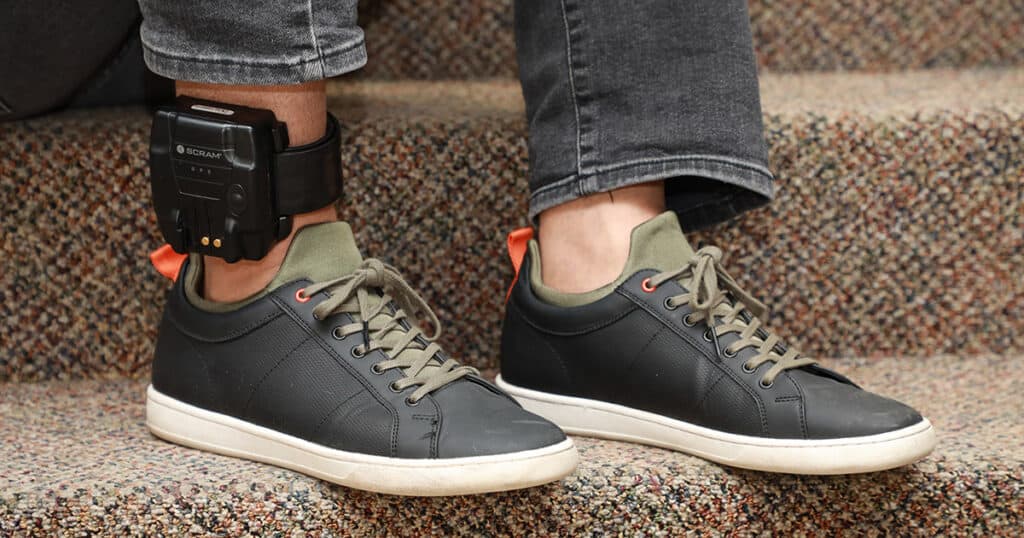
Ankle monitors are visible under pants, particularly if you are wearing lightweight fabric or a work uniform. Wearing darker pants, loose-fitting trousers, or long socks can reduce visibility. If the size of the device is causing issues at work, contact your monitoring provider. Some clients are provided with a protective sleeve that makes the device less bulky under clothing.
In most situations, there is no general legal requirement to disclose your monitoring status to a private employer. However, certain licensed professions and positions requiring security clearances may have their own reporting obligations. If you hold a professional license or work in a regulated industry, speak with your attorney before making any decision about disclosure.
GPS Signal in Large Buildings
GPS signals can weaken or drop inside large concrete structures, basements, warehouses, or areas with significant metal shielding. If you work in an environment like this, let your supervising officer know before you start. Most monitoring providers can account for this in the monitoring protocol so that signal loss during your approved work hours does not generate a false violation alert.
A good practical habit is to step outside during breaks and lunch, even briefly, to allow the device to reacquire a strong GPS signal. It is also worth knowing that most modern monitoring devices are Wi-Fi enabled, which gives the system an additional location tracking point beyond GPS alone. In environments where GPS struggles, a nearby Wi-Fi network can help fill in the gap and keep your location data consistent throughout the day.
Charging the Device
Most GPS ankle monitors require daily charging. Depending on your device, charging may take one to two hours while the device remains on your ankle. If you have a long work shift, plan your charging schedule around it. Some clients charge before and after work. A dead battery generates an alert the same way a real violation does, so building a consistent charging routine is essential.
Going to School on an Ankle Monitor
Going to school works the same way as going to work. Your campus address, class schedule, and hours need to be programmed into your monitoring system by your supervising officer. If you have classes on different days at different times, all of that needs to be accounted for in the schedule.
For online classes taken from home, no additional approval is typically needed since you are at your approved address. If your program includes any in-person requirements, labs, practicums, or campus visits, make sure those are in your approved schedule as well.
Study groups or library visits off campus are separate from your class schedule and need their own approval if they fall outside your approved hours. Do not assume they are automatically covered because they are school-related.
What to Do If Your Schedule Changes Unexpectedly
Sometimes a shift gets added with little notice. A professor changes a class time. You are asked to stay late. Life does not always cooperate with pre-approved schedules.
If something changes unexpectedly and you are going to be somewhere outside your approved schedule or hours, contact your supervising officer before you go, not after. Calling ahead gives your officer the chance to note the change and avoid an alert being treated as a violation. Calling after the fact, when an alert has already been triggered, puts you in a much harder position to explain.
If you cannot reach your supervising officer directly and have an urgent situation, contact your monitoring provider. A 2nd Chance Monitoring provides 24/7 support so clients are never left without someone to call when something unexpected comes up.
What If You Miss Work or School Days?
If you have a day off, call in sick, or have a change that means you are staying home, you do not need to do anything specific as long as you are at your approved home address. The system will simply show you at home during hours that were previously programmed as a work or school departure. That is not an alert by itself.
What matters is that you are where the system expects you to be, or that any deviation is pre-approved. Staying home when you were scheduled to be at work is not a problem. Leaving home when you were not approved to do so is.
Frequently Asked Questions About Working and Going to School on an Ankle Monitor
Can you work with an ankle monitor?
Can you go to school while wearing an ankle monitor?
Does your employer have to know you are wearing an ankle monitor?
What happens if you have to stay late at work or miss a class?
Can a GPS ankle monitor lose signal at work?
What if your work schedule varies week to week?
About A 2nd Chance Monitoring
We believe everyone deserves a second chance. A 2nd Chance Monitoring provides alcohol monitoring, GPS tracking, and communication services to help individuals stay accountable while they navigate legal requirements or work toward personal goals. With multiple locations across Georgia and Alabama, our team offers professional support and reliable technology you can count on 24/7. Whether you’re fulfilling a court order or simply looking for structure during a difficult time, we’re here to help. Get in touch with us today.
The information in this article is provided for general educational purposes only and does not constitute legal advice. Monitoring conditions, approved activities, and schedule requirements vary by jurisdiction and by individual court order. If you have specific questions about your monitoring conditions, contact your supervising officer or a licensed attorney. A 2nd Chance Monitoring is not a law firm.